
Sheriff Release Paths
The Big Stone County Sheriff’s Office handles arrests, law-enforcement records, transport information, and public contact. It does not operate a county jail. An official Minnesota legislative study identifies Big Stone as a county without a jail facility. A person arrested locally may leave after processing, post bond at the place of custody, remain at a receiving jail, or move to another custodian. The local agency name therefore does not establish where the person slept, where property was processed, or which jail entered a release time.
A community release can follow a bond order, dismissal, time-served sentence, or other court authority. A departure can also be a transfer. The receiving jail may send the person to another county, the Minnesota Department of Corrections, a federal custodian, a court-ordered placement, or ICE. Each event needs its full label. “Released from the jail” proves departure from that jail only. It does not, by itself, prove that all custody ended.
Big Stone Has No Jail
The no-jail finding is the most useful facility fact in a Big Stone County release search. The official Sheriff page has no current inmate roster, recent-release table, booking-photo gallery, or verified jail app. That absence is consistent with the legislative finding. Commercial pages that use the phrase “Big Stone County Jail” do not create an official jail or a reliable county release list.
One surrounding county should not be assumed for every arrest. Lodging can change with placement arrangements and available beds. Even a receiving jail that handled one Big Stone County case may not handle the next. For a named person, provide the Sheriff with the full name and an approximate arrest date. Ask which agency accepted custody and on what dates. Then contact that exact jail. This step avoids searching the wrong roster and mistaking a no-match for release.
The official Sheriff screenshot below shows the local contact route and the absence of a jail lookup link. Review the current Sheriff page before calling because office information can change.
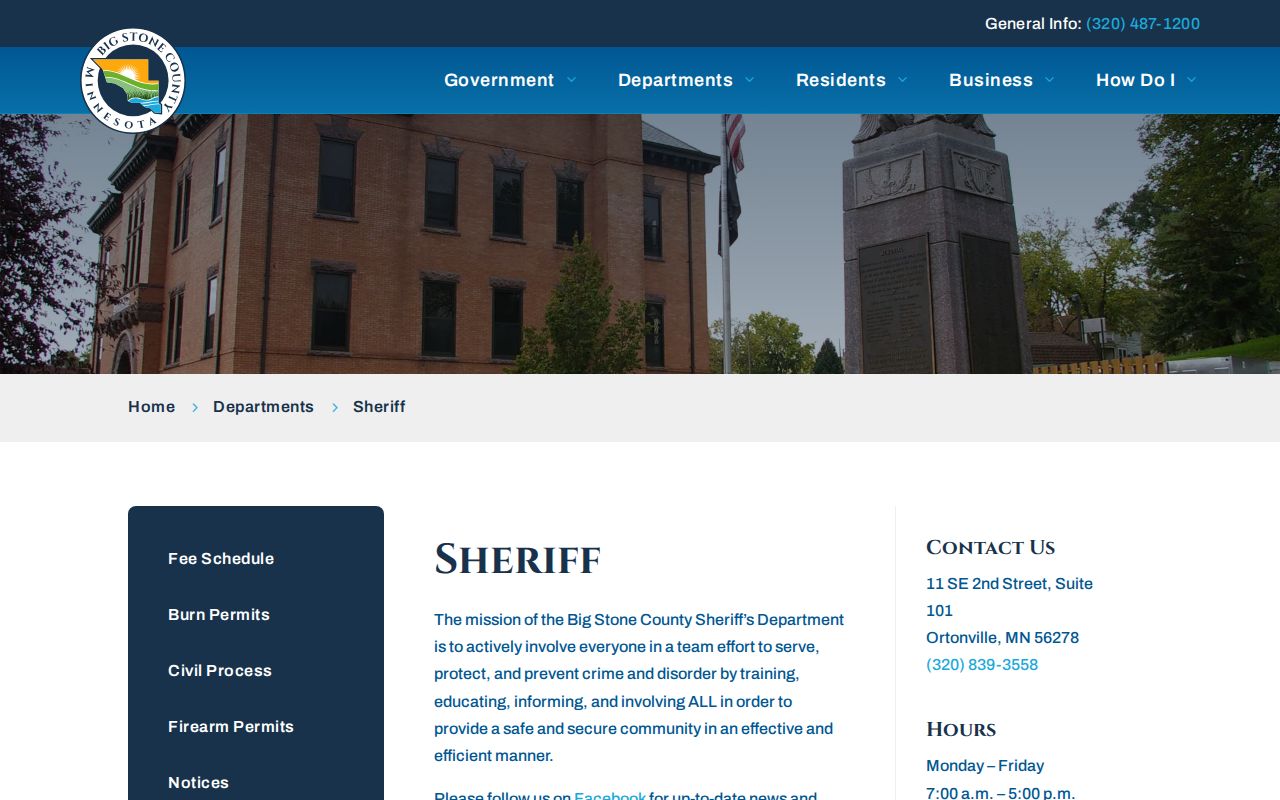
The page supports the first step in the search: identify the custodian rather than rely on an assumed Big Stone jail roster.
Note: Public office hours are contact hours, not a promised schedule for release processing at another county’s jail.
Confirm Sheriff Release Records
A release check begins with the Big Stone arrest trail, then follows the person to the physical custodian. Court data help explain the legal basis. The Minnesota Court Records Online system can show a Big Stone County case, bond order, dismissal, sentence, warrant, probation, or commitment to the Commissioner of Corrections. A court entry explains authority, but the jail record remains the best source for the actual time someone left that building.
- Search the court case by party or known case number and select Big Stone County. Confirm the person and read the events in date order.
- Call the Sheriff with the person’s name and approximate arrest date. Ask for the actual lodging facility and transport dates.
- Use that facility’s official roster or release view. If the name is absent, ask whether the event was release or transfer.
- Request the receiving jail’s release transaction, including the event time, authority, and destination if maintained.
- Request Big Stone County’s arrest, booking, lodging, and transport data for the same date range.
A current roster answers only whether a person appears in that facility now. It is weak proof of a past release. Names also disappear after transfers. For a person sentenced to state prison, use the MN DOC Public Viewer while the person remains under state jurisdiction. For a federal case, use the BOP locator after BOP designation. The Big Stone County released inmate search explains how those systems fit together.
Two Records Prove Release
Big Stone County release verification is often a two-record chain. The Sheriff may own the arrest report, transport log, and a record of the lodging destination. The receiving jail may own the jail-management entry that records intake, property handling, bond processing, transfer, and physical departure. Neither agency should be assumed to hold every part of the event.
Requesting both sides prevents a common error. A person can vanish from the Sheriff’s immediate view because transport is complete, yet remain confined at the receiving jail. The same person can vanish from that jail because DOC, USMS, another county, or ICE accepted custody. Only the event type and destination show whether departure meant a return to the community.
| Record holder | Useful maintained fields |
|---|---|
| Big Stone County Sheriff | Arrest date, agency, local booking data, transport date, lodging facility, transfer destination |
| Receiving jail | Jail admission, booking number, property record, release date and time, release authority, transfer transaction |
| District court | Case number, bond order, disposition, sentence, warrants, probation, commitment, discharge entry |
This chain-of-custody method is the distinctive local rule. It uses the office that created each record. It also leaves room for lawful redactions and for fields that one agency never maintained.
Sheriff Records and Contact
The Sheriff’s public contact information is useful for identifying placement. The county data-practices policy lists a second responsible-authority number for written Chapter 13 requests. Because those sources differ, confirm the preferred delivery method before sending personal identifiers. Do not send sensitive data through a social-media message.
Big Stone County Sheriff’s Office
11 SE 2nd Street, Suite 101
Ortonville, MN 56278
General: 320-839-3558
Monday–Friday, 7:00 a.m.–5:00 p.m.
Saturday–Sunday, 8:30 a.m.–6:30 p.m.; weekend hours may vary
For a written request, use the Big Stone County Data Practices Policy and form. The policy lists the Sheriff’s responsible-authority contact at 11 Second Street SE, telephone 320-839-5990, and fax 320-839-5980. Ask for inspection, electronic copies, or both. Inspection of public data is free. Copy costs depend on format and the current county schedule, so ask for an estimate before work begins.
Describe existing data rather than ask the county to create a custom release list. A narrow request can name the person, date range, arresting agency, booking date and time, lodging facility, transfer date and destination, release time, release authority, charges, bond data, and booking photograph. If data are withheld, ask the office to identify the legal basis.
Note: The county’s public-request response standard is prompt and reasonable, but it is not a fixed deadline for every request.
Read Sheriff Release Fields
Release terms are system-specific. “Bond release” means the jail acted on the bond authority for that custody event. “Time served” describes a sentence outcome, but another warrant or hold can continue custody. “Transfer” means the person left one agency while another took charge. “Supervised release” is a Minnesota prison term for leaving prison while remaining under DOC authority. “Discharge” means the sentence or agency jurisdiction ended.
- Custodian
- The agency or facility with physical or legal control at that point in time.
- Release authority
- The order or legal reason that permitted departure, such as bond, dismissal, or sentence completion.
- Detainer
- A request or hold that can cause transfer to another agency instead of community release.
- Discharge
- The end of a sentence or supervising agency’s jurisdiction, not just exit from a building.
Read dates with their labels. Arrest, intake, transport, release, supervision start, and final discharge are different events. Compare the Sheriff record with the receiving jail transaction and court order. If the data conflict, ask each office which system produced the field and when it was last updated.
Track the Next Custodian
The next lookup depends on the destination. A surrounding-county jail controls its own current roster and release transaction. The Minnesota Department of Corrections controls prison and supervised-release data for people committed to the Commissioner. The BOP locator covers many current and former sentenced federal prisoners. ICE’s locator covers current detention and a limited recent-release window. Minnesota VINE can send custody-change notices for participating county jails, but the reporting facility must be the real receiving jail.
No-match results need care. A released person may fall off a live jail roster. A fully discharged person may fall outside Public Viewer’s scope. A person who left one system may still be held in another. Return to the named custodian, the court file, and a focused records request instead of treating silence as proof.
That distinction protects the accuracy of the Big Stone County Sheriff release record. It also answers the practical question that matters most: not merely whether a name disappeared, but where the person went and which office can confirm the event.