
Federal BOP Release Scope
The Federal Bureau of Prisons operates a national prison system for people in federal custody after sentence and for some other defined populations. It is relevant to Big Stone County only when a federal prosecution, designation, or transfer placed the person in BOP custody. A Big Stone arrest, a stay in a surrounding-county jail, or a Minnesota state sentence does not create a BOP record by itself.
The BOP Inmate Locator generally covers records from 1982 forward. It can return current and many former federal prisoners. A person held only by the U.S. Marshals Service before trial may not have the same locator history, especially if the person was acquitted, released by the court, or never reached a BOP designation. Start with the federal court case when custody type is unclear.
Search Federal BOP Releases
BOP provides two main search paths. A number search accepts supported federal identifiers, including the formatted BOP register number. A name search uses first and last names, with optional middle name, race, age, and sex filters. A register number is more precise. With a name, compare every displayed descriptor before selecting a result.
- Open the official BOP locator and choose number search when a register number is known.
- Otherwise search the full name and use available descriptors to narrow the result.
- Compare the register number, age, race, and sex fields before treating a row as a match.
- Read the release date and location or status together.
- If the date is in the future, treat it as projected rather than completed.
- If the person never appears, check the federal docket, USMS path, physical jail, and BOP records process.
The official BOP search interface is shown in the captured image below.
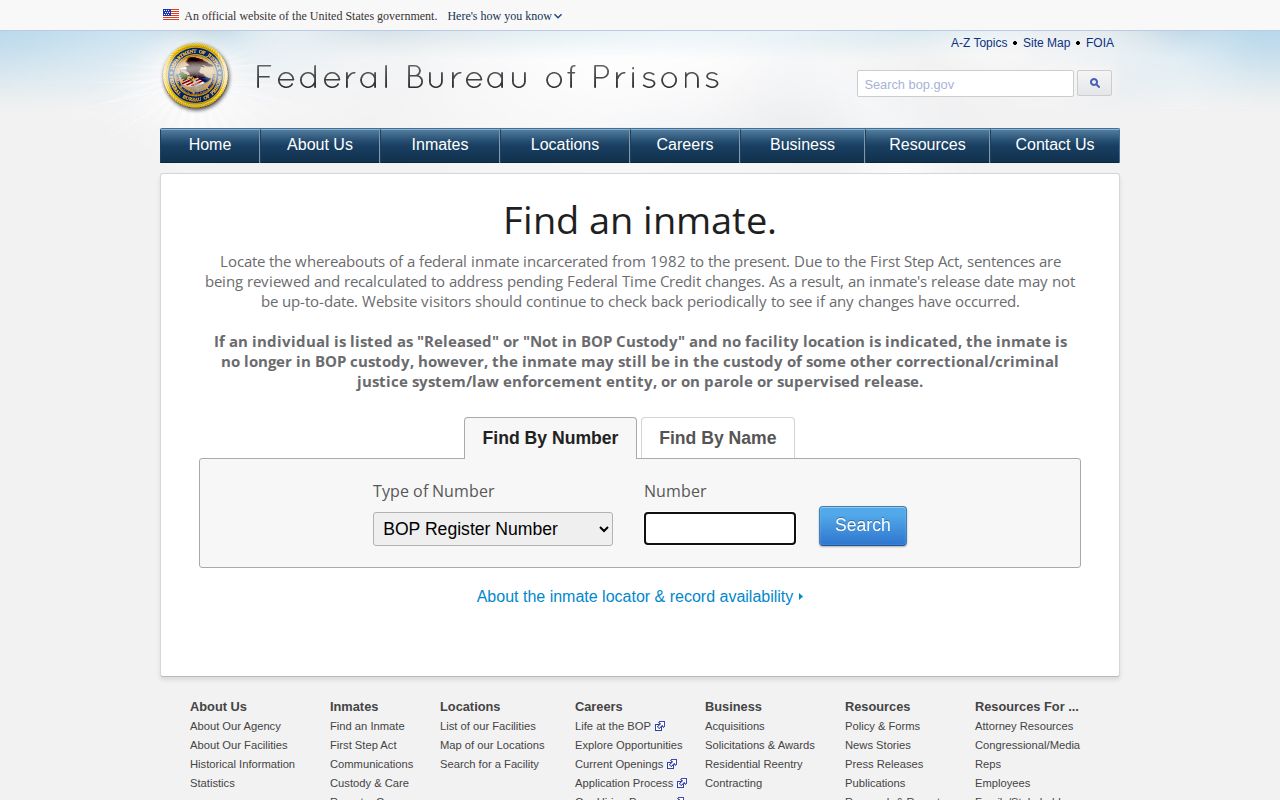
The interface is nationwide. It does not provide a Big Stone County jail roster, and it should be used only after the federal-custody connection is established.
Read Federal Release Results
BOP results commonly show name, register number, age, race, sex, release date, and location. A past date paired with “Released,” “RELEASED,” or “Not in BOP Custody” indicates that BOP no longer holds the person. BOP itself warns that the person may remain in another correctional system or under supervision. A later state or local arrest also falls outside what that older federal release row proves.
| BOP display | Careful interpretation |
|---|---|
| Federal facility name | The person is shown at that BOP location, subject to update timing. |
| Future release date | The date is projected and can change after sentence-credit recalculation. |
| Released / Not in BOP Custody | The person left BOP custody; other custody or supervision may continue. |
| Unknown release date | The term may not yet be determined, including some pretrial or unsentenced cases. |
| No match | Identity, date range, USMS-only custody, or older archival coverage may explain the result. |
BOP extracts update daily, and credit calculations can create temporary differences. Do not state a projected date as an accomplished release. For legal completion, check the federal judgment, sentence, supervision terms, and later docket events.
Note: A federal release date does not establish the end of every sentence-related obligation or the absence of later custody.
USMS Transfer Versus BOP Release
The U.S. Marshals Service prisoner program handles many federal detainees from arrest through acquittal, court-ordered release, or transfer to a designated BOP facility. USMS may use federal, state, local, or private beds. A person can therefore leave a surrounding-county jail on a federal writ or USMS transport without entering the community.
USMS does not offer a general public historical release locator comparable to BOP’s. Follow the federal docket, ask the physical jail for its release or transfer transaction, and contact the appropriate federal office when public information is needed. If BOP later accepts the person, the BOP locator becomes the public path for federal prison location and many release results.
The timing of federal custody matters. A local jail may show a person leaving on a writ for a hearing and later returning. It may instead show final transfer to USMS after the local case ends. Neither event establishes BOP designation. Match the jail movement date against the federal docket and any return entry. If the person was never sentenced to BOP custody, a missing BOP result may be expected rather than evidence that a release record vanished.
- Federal writ
- A court command that can move a person for a federal proceeding while other custody continues.
- Designation
- BOP’s assignment of a sentenced person to a federal facility.
- Register number
- A federal identifier used for a more precise BOP search.
- Community supervision
- Post-prison oversight that can continue after physical federal custody ends.
Ask which agency held the person on the date in question. Facility departure and legal release are separate facts.
Big Stone Federal Record Chain
Federal custody can intersect with the Big Stone chain at several points. The Sheriff or Ortonville Police may document a local arrest. A surrounding jail may document physical admission and a later transfer. A federal court docket can identify the federal authority. USMS may control pretrial movement, and BOP may control post-sentence prison custody. Each source should answer the event it created.
Begin by asking the Big Stone County Sheriff which facility physically held the person and whether the transfer record names a federal agency. Then request the receiving jail’s departure transaction. A “release to USMS” entry means custody changed hands. It should not be described as a community release. If a later BOP result says “Released,” that later event concerns BOP custody only.
| Stage | Primary source |
|---|---|
| Local arrest and transport | Big Stone County Sheriff or Ortonville Police |
| Exit from the lodging jail | Actual receiving jail’s release or transfer transaction |
| Federal case authority | Federal court docket and judgment |
| Federal pretrial movement | USMS and the physical custodian |
| BOP prison release | BOP locator, BOP records, and court record |
This record sequence preserves the core Big Stone rule: disappearance from one agency’s system is not proof of community release.
Federal BOP Release Records
When the locator does not provide enough detail, use the BOP Freedom of Information Act route. A focused request can identify the person by full name, register number, date of birth, facility if known, and date range. Ask for public admission, transfer, designation, and release information rather than an undefined complete file. Identity authorization, including DOJ-361, may be needed for records protected by privacy law.
Keep the request tied to BOP. The federal court clerk controls filed judgments and docket records. USMS controls its own prisoner movement data. A contract jail controls its physical admission and departure entries. Sending the same broad question to BOP cannot compel it to reconstruct records created by those offices. Route each event to its originating agency and compare the responses by date and identifier.
For records before the locator’s general 1982 coverage, BOP points users toward the National Archives. Provide approximate age, conviction location, facility, and custody dates when known. Older records often require more than a name. The federal court docket can help supply the case number, sentence date, and district.
Federal Bureau of Prisons
Nationwide system
Use the official Inmate Locator for public status
Use BOP FOIA for record detail
Identify the actual BOP facility before seeking facility-specific contact information.
No fixed BOP facility address or capacity should be assigned to Big Stone County. The systemwide page covers any federal facility that actually held the named person. Confirm that facility from the locator, federal docket, or BOP response before using its visiting, mail, or release information.
After a Federal Release
A BOP release can lead to supervised release, another custodian, an approved residential placement, or sentence completion, depending on the federal judgment and agency record. Immigration custody is separate. If a record says ICE accepted the person, use ICE’s official locator and read that event as a transfer from criminal custody into civil detention.
A Big Stone County court search does not replace the federal docket, just as the BOP locator does not replace a county jail record. Use the Big Stone County release search paths to identify the local stage, then use the federal tools for the federal stage. The result should state which system released the person, on what date, and whether another source records continued custody.
Precise labels make the record useful. “Released from BOP custody” is supported by a BOP result. “Released to the community with no other custody” requires more evidence.