
Big Stone Projected Versus Actual Release
A projected or anticipated release date is a current calculation. It reflects the sentence, credited time, governing statutes, agency data, and known holds at the time of calculation. The actual release date records what occurred after the custodian completed processing. These dates can differ without either record being false. A later court order, discipline, corrected credit, another warrant, or a statutory rule may move the projection.
Pretrial custody works differently. A person held before sentence has no sentence-completion date. Release may depend on bond, dismissal, a court-order change, or resolution of another hold. A court calendar date is not a release date. Likewise, a person’s disappearance from a receiving jail roster does not prove community release because transfer remains possible.
- Projected release date
- The agency’s current estimate based on the law and facts then recorded.
- Actual release date
- The date custody ended or changed as documented after the event.
- Detainer
- A request or legal hold that may keep a person in custody for another authority.
- Jail credit
- Qualifying time already spent in custody that is applied to a sentence.
Find Big Stone Projected Release Dates
The first lookup question is not the person’s name. It is the custody system. Big Stone County does not operate a jail. The Sheriff may process an arrest and arrange lodging elsewhere, while the actual receiving jail calculates and records a short local sentence. A person committed to the Commissioner of Corrections follows MN DOC rules and systems. Federal and immigration custody use still other records.
- Read the Big Stone criminal case in Minnesota Court Records Online and identify whether the person is pretrial, locally sentenced, or committed to DOC.
- For local custody, ask the Big Stone County Sheriff’s Office which jail physically holds the person.
- Request the receiving jail’s current calculation and ask whether another hold affects release.
- For a state prisoner, search the official MN DOC locator route by name or full six-digit MNDOC number.
- Compare any displayed date with the judgment, offense date, sentence structure, and current DOC or jail confirmation.
DOC says its name search is prefix-based and checks names associated with conviction history, while results display the current DOC name. Newly sentenced people can take several business days to appear. If a projected or anticipated field is not displayed on the chosen live record, do not infer one from another person’s result. Use DOC records or the responsible office.
The official MN DOC anticipated-release example shows the type of live record that must be read by its exact label.
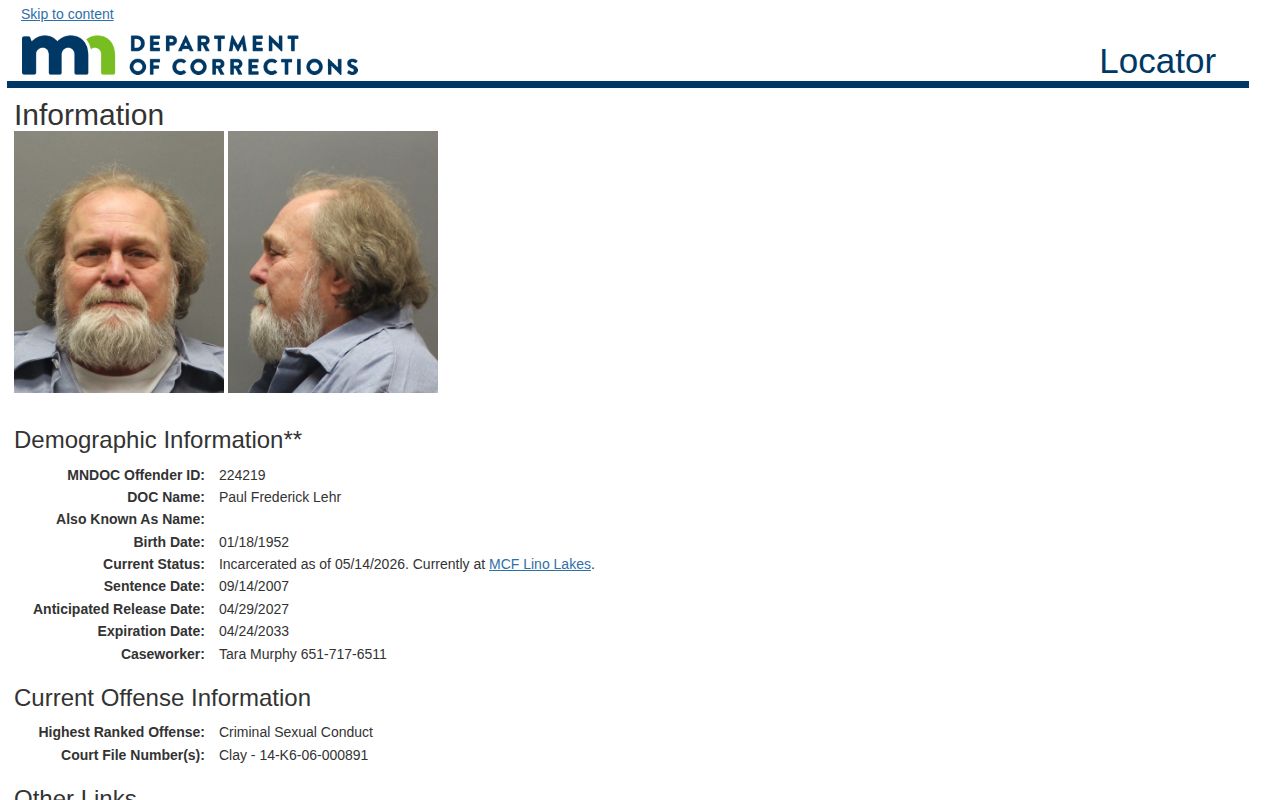
The result demonstrates why identity, current status, and agency wording must be checked together before quoting a projected date.
Minnesota Prison Release Framework
For ordinary covered determinate sentences, Minnesota’s public explanation uses a confinement portion followed by a supervised-release portion. Section 244.05, subdivision 1b, generally sets the supervised-release term at one-third of the fixed executed sentence for covered post-August 1, 1993 felony offenses, subject to disciplinary confinement and the statute’s other provisions. This is commonly described as two-thirds confined and one-third under community supervision.
Supervised release is still part of the sentence. It is not the same as final discharge. A person may leave prison, live in the community under conditions, and remain within DOC jurisdiction. Conditional-release statutes, special sentence types, and Board-controlled cases may follow different rules, so the ordinary fraction cannot be imposed on every Big Stone sentence.
Minnesota also does not use a universal 85-percent rule. Importing that shorthand from another state produces a poor estimate. Start with the actual judgment, offense date, and Minnesota statute. Then account for jail credit, discipline, earned-credit eligibility, and other sentence-specific facts.
Note: The state-prison framework must not be used to calculate a short sentence at the surrounding county jail that holds a Big Stone detainee.
Big Stone Earned Release Credit
The Minnesota Rehabilitation and Reinvestment Act created earned incentive release credit through an individualized rehabilitation plan. Sections 244.41 through 244.46 govern definitions, eligibility, credit, exclusions, use, and revocation. Section 244.41 ties the credit to objectives in the plan, while current section 244.44 controls how credit is applied.
Current law can allow earned credit of up to 17 percent of the total executed sentence to be subtracted from imprisonment, while preventing reduction below one-half of that executed sentence. This is not an automatic subtraction. A person must be eligible and must earn the credit. Program rollout, effective dates, exclusions, plan progress, and actual awards matter.
The MN DOC implementation page should be read with the live statute. A defensible calculation begins with the judgment and offense date, establishes the statutory baseline, applies jail credit and disciplinary confinement, and only then checks eligibility and the credit actually awarded. It never promises release by subtracting 17 percent from the sentence.
What Changes Big Stone Release Dates?
A projection can move for more than one reason. Some factors change the length or structure of confinement. Others do not change the sentence but prevent physical release to the community. The custodian should identify which factor is active rather than giving a bare date.
| Factor | Possible effect | Record to check |
|---|---|---|
| Jail or prison credit | Corrects how prior custody counts toward the term | Judgment, credit order, and agency calculation |
| Disciplinary confinement | May extend confinement or affect release timing | DOC sentence and discipline record |
| Earned incentive credit | May reduce imprisonment when lawfully earned and applied | DOC plan and credit determination |
| Resentencing or correction | Changes the controlling sentence terms | Later court order and amended judgment |
| Concurrent or consecutive terms | Changes how multiple terms overlap or follow one another | Sentencing judgment and DOC computation |
| Warrant, detainer, or hold | May shift the person to another custodian instead of the community | Holding agency and court record |
| Board or special statute | Can control a qualifying projected date or later decision | Board material and offense-specific law |
A placement or transfer date is also not the same as release. If the receiving jail says its local hold ended, ask whether DOC, USMS, ICE, or another county took custody. The Big Stone County released-inmate search describes the wider chain.
Big Stone County Jail Calculations
No single “Big Stone County jail calculator” exists because the county has no operating jail facility. A short local sentence can depend on days imposed, sentence start, jail credit, concurrent or consecutive terms, the receiving jail’s lawful good-time policy, work-release status, and other holds. The Big Stone judgment supplies the legal sentence. The physical receiving jail supplies the custody calculation and release transaction.
Ask the Sheriff to identify the actual jail before requesting a date. Then give that jail the person’s full name, booking identifier if known, Big Stone case number, and the judgment date. Ask for the current scheduled date, credit applied, any unresolved holds, and whether the expected event is community release or transfer.
The state two-thirds and one-third prison model does not govern a local jail term merely because the Big Stone case is in Minnesota. No Big Stone-specific local good-time policy was verified in the research. Avoid doing independent arithmetic from a docket entry when the receiving jail maintains the official calculation.
MCRO can supply the judgment and later sentencing orders, but it does not calculate the hour of physical release. A “time served” disposition may end one case while another warrant or hold keeps the person confined. When remote documents are missing, request the sentencing order from Big Stone District Court and ask the receiving jail which order controls its current date.
When Minnesota Moves Release Dates
Minnesota’s scheduled-release weekend rule is not the common “release on Friday” shortcut. Section 244.05, subdivision 1a, distinguishes offense dates. For offenses on or after August 1, 1992, a scheduled release falling on Friday, Saturday, Sunday, or a legal holiday moves to the first following day that is not one of those days.
Specified older offense dates use a different direction under the statute. That makes the offense date essential. A calendar-only estimate can move the release the wrong way. Read the current statutory text and confirm the applied date with DOC.
This state-prison rule also does not establish the surrounding county jail’s release practice. The actual receiving jail must compute a local Big Stone sentence under the court order and its lawful rules. Holiday staffing, transport, another hold, or transfer processing can still separate a scheduled date from the time the person physically leaves.
Big Stone Board Projected Dates
The Minnesota Supervised Release Board has limited jurisdiction. It may handle qualifying life or indeterminate sentences and certain other statutory categories. Its initial readiness review does not create a right to release before the minimum eligibility date. The Board may assign a projected release date or continue the case with directives.
Use the official Board schedule for dated agendas, minutes, recordings, and meeting details. No complete all-person decision database was verified. Prior meeting materials stay available for a limited period, so approved minutes and the annual report can become the better history source.
Eligibility varies by sentence type and offense law. A single minimum-year rule would be wrong. For an ordinary determinate prisoner, use the supervised-release calculation and current DOC record rather than treating every projected date as a Board decision.
Confirm Big Stone Release Timing
A final check should match four facts: the correct person, the controlling judgment, the current custodian, and the date label shown by that custodian. For local custody, confirm with the receiving jail. For state prison, confirm through the Public Viewer or DOC. If the date came from a Board document, check for later action.
For county-jail notification, register against the correct receiving facility through the VINELink Check. For DOC incarceration or community supervision, Minnesota Haven is the separate notice path. Alerts can lag, and an event can describe transfer rather than community release.
If the online record is missing or no longer current, use a narrow request. The Big Stone court can provide the judgment or release order. The receiving jail can provide its release transaction. The DOC data-request page handles state offender records. An actual release record should replace the projection once the event has occurred.