
Minnesota DOC Release Scope
Minnesota State Correctional Facilities are state prisons operated by the Minnesota Department of Corrections. They hold people committed to the Commissioner of Corrections after an executed prison sentence. A person arrested or briefly jailed on a Big Stone County matter does not enter the DOC search unless the case led to state commitment. Big Stone County’s lack of a jail building does not turn a receiving-county jail stay into state-prison custody.
The MN DOC Public Viewer covers adults committed to the Commissioner who remain under DOC jurisdiction. That group includes people in prison and people released from prison who remain on community supervision. Public Viewer is not a statewide arrest database or a county-jail roster. Its scope, not just spelling, explains many no-match results.
Search Minnesota DOC Releases
The direct Viewer accepts a full six-digit MNDOC offender ID or a name. DOC says its name search is prefix-based and checks names linked to the person’s criminal conviction history, although results display the current DOC name. Newly sentenced people may take several business days to appear. Use the offender ID when known because it is more precise than a name.
- Open the official Public Viewer and enter the six-digit MNDOC ID, or search by first and last name.
- Open the matching profile only after comparing the available identity details.
- Read the custody or supervision status together with the facility or supervising location.
- Read each date label literally. Do not turn a projected or anticipated date into an event that already occurred.
- If the record shows community supervision, treat the person as released from prison but not discharged from DOC.
- If there is no result, search the Big Stone court case and use a formal DOC data request.
The official Minnesota DOC search screen shows the proper starting point for a state-prison release lookup.
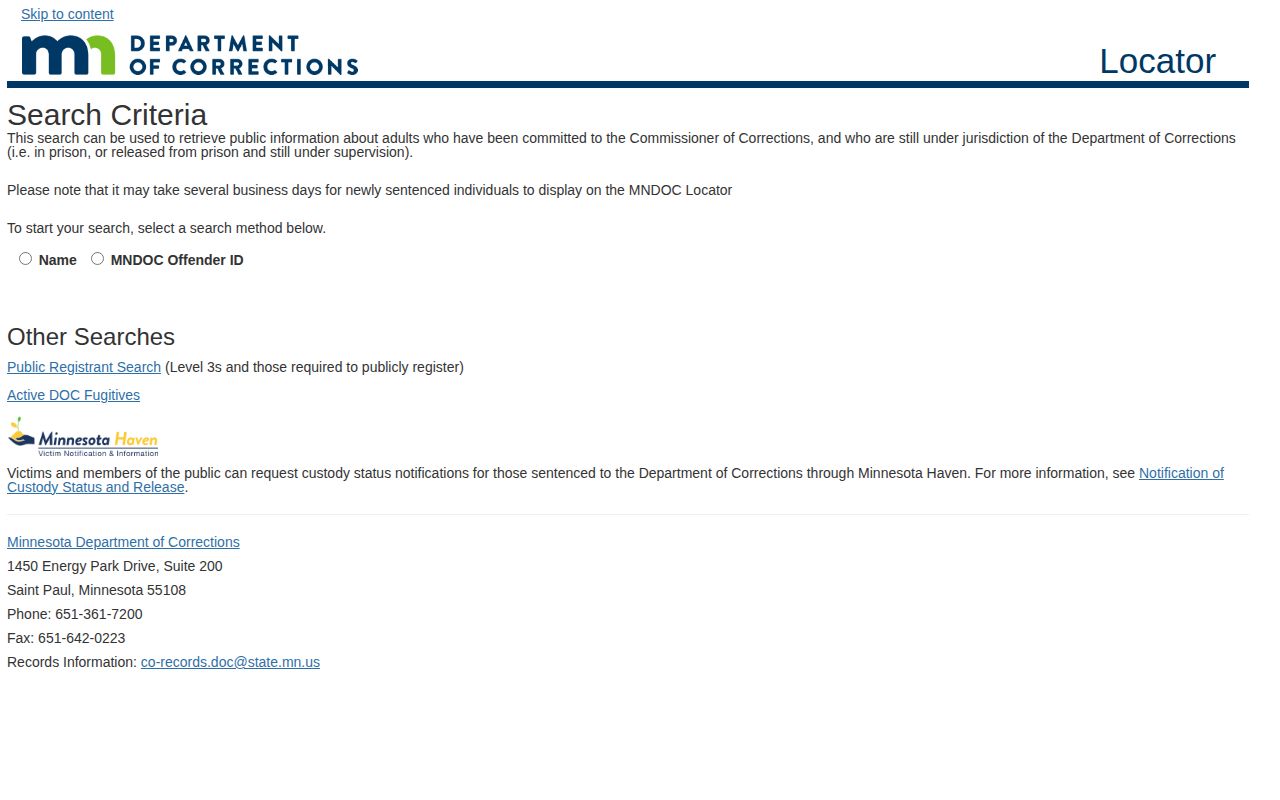
The screenshot confirms the statewide search route. It should never be presented as a roster for the Big Stone County Sheriff or a surrounding-county jail.
Read Minnesota DOC Release Status
Prison release has several stages. “Confinement” means the prison portion of the sentence. “Supervised release” means the person serves the community portion under stated conditions. “Parole” applies only to limited Minnesota sentence categories and should not be used as a general label for every prison exit. “Discharge” or “expiration” marks the end of sentence or DOC jurisdiction.
| DOC term | Meaning for a Big Stone case |
|---|---|
| Incarcerated | The person remains in a Minnesota state correctional facility or DOC placement. |
| Community supervision | The person has left prison but remains under DOC jurisdiction. |
| Projected or anticipated date | A prospective date that can change under sentence law and administration. |
| Transfer or placement | The physical location changed while legal custody or supervision continued. |
| Discharge or expiration | The sentence or DOC jurisdiction ended; Public Viewer coverage may end too. |
A profile can show that a person left prison for supervision without proving that every court obligation ended. Conversely, a no-match does not prove that no prison history exists. Fully discharged people can fall outside the Viewer’s stated universe. Use the sentencing docket and DOC records for history.
The manifest includes an official Public Viewer result that demonstrates released-to-supervision status. Review the source record for the interface context.
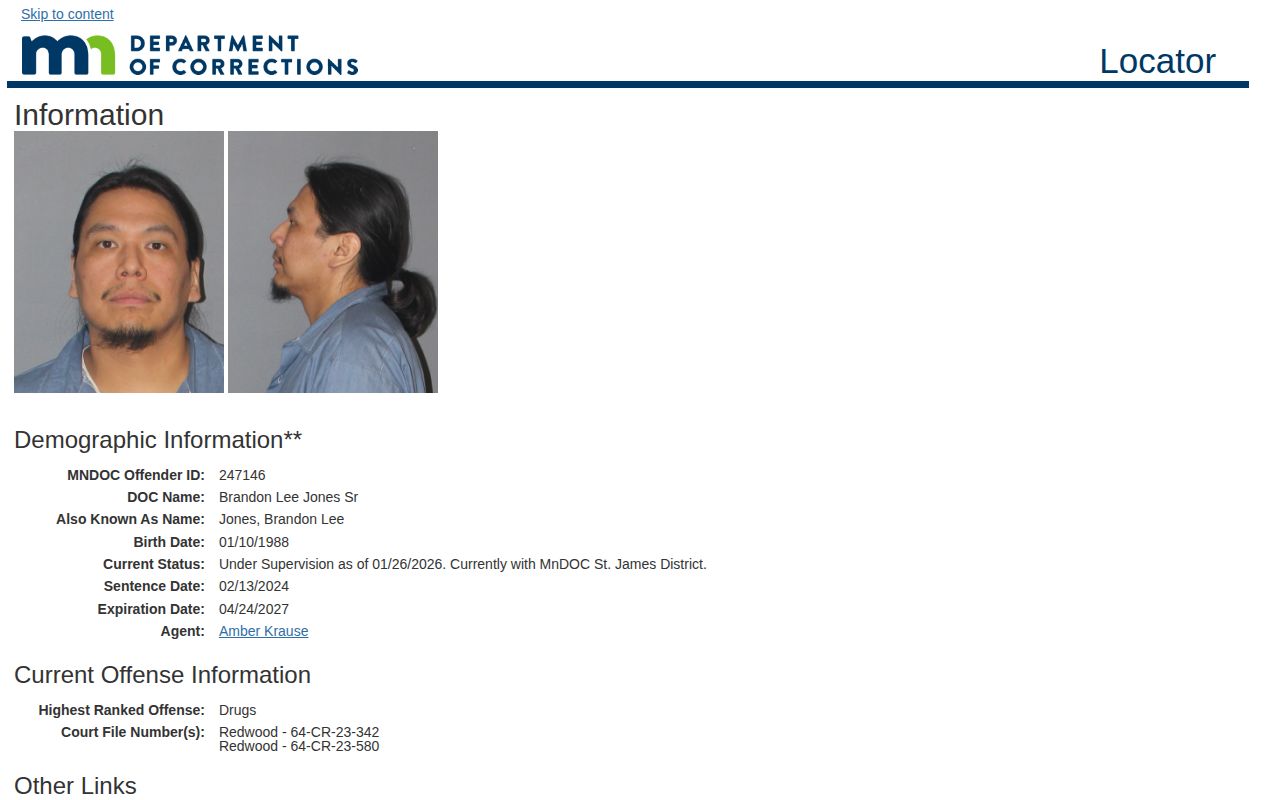
The result illustrates why prison exit and final discharge must be treated as separate dates.
Minnesota Prison Release Framework
Minnesota’s ordinary determinate sentencing structure is not an across-the-board 85-percent rule. DOC’s public explanation describes a traditional model of two-thirds of the fixed executed sentence in confinement and one-third on supervised release. Minnesota Statutes §244.05 governs supervised release and contains exceptions, discipline provisions, release-day rules, and special sentence categories.
The Minnesota Rehabilitation and Reinvestment Act adds earned-incentive release credits through §§244.41–244.46. Credit depends on eligibility and progress in an individualized rehabilitation plan. It is earned, not automatic. Current law allows qualifying credit within statutory limits, but a reader should never subtract a flat percentage and announce a release date. Court corrections, sentence credit, disciplinary confinement, consecutive terms, holds, special conditional-release law, and Board action can change the calculation.
- Executed sentence
- A prison sentence placed into effect by the court.
- Supervised release
- The community portion of a Minnesota prison sentence while DOC jurisdiction continues.
- Earned credit
- A statutory confinement credit tied to approved plan goals and eligibility.
- Discharge
- The end of the sentence or DOC authority, not merely release from prison walls.
For a county-jail sentence served in a surrounding county, consult the sentencing order and actual jail policy. The state-prison two-thirds and one-third structure must not be copied onto a local jail calculation.
Note: The exact field shown on a DOC profile controls; projected, confinement-release, supervised-release, and expiration dates are not synonyms.
Minnesota DOC Release Records
Public Viewer is a live public locator, not the full historical file. Use the MN DOC data-request route when a person is fully discharged, a field is absent, or an official record is needed. Supply the full name, DOC number when known, birth date where appropriate, Big Stone sentencing county and case, and a narrow date range.
Ask separately for admission, facility movements, prison release to supervision, final discharge, and any public image or status field that the agency maintains. A narrow list helps the records office identify responsive data. DOC may withhold or redact protected medical, victim, security, juvenile, or other nonpublic material. Requesting public fields does not guarantee an unrestricted copy of the full correctional file.
Minnesota law also provides a historical reporting layer beyond Public Viewer. Section 13.87 makes specified Bureau of Criminal Apprehension conviction data public for a defined period after sentence discharge, including identity, offense, disposition, controlling agency, and confinement information. Section 299C.14 addresses the reporting of release and discharge facts. Those statutes classify and require data handling, but they do not promise a free public name-search screen for every historical record. Use the responsible agency’s access process and identify the exact public fields sought.
Minnesota Department of Corrections
1450 Energy Park Drive
St. Paul, MN 55108
651-361-7200
Use the official online data-request instructions for offender records.
The MCRO case record is the other durable route. Read the Big Stone County judgment, executed sentence, jail credit, commitment entry, later amendments, and discharge events in order. A judgment proves the sentence. An agency discharge record or later court entry is stronger proof that the sentence ended.
Big Stone Release Record Chain
A state-prison path can begin with two local records. Big Stone County may document the arrest and transport, while a surrounding jail owns the initial physical custody transaction. The court judgment then supplies the legal bridge into DOC custody. Public Viewer and DOC records cover the state phase. Keeping those records in sequence avoids calling a jail-to-prison transfer a community release.
When the person first leaves the receiving jail, ask for its destination. If the record says commitment or transfer to DOC, wait for state intake and search the statewide system. When the DOC record later says supervised release, the person has left prison. A final discharge is a separate event. Each agency confirms only the part it created.
This chain is especially important because Big Stone County has no jail roster to serve as a single local hub. The Big Stone County release-record search connects county, court, and state channels, while the DOC record remains the controlling source for state-prison status.
After Minnesota Prison Release
A person may leave a Minnesota state prison for community supervision, an approved placement, limited parole, or another lawful movement. The supervising office cannot be inferred solely from the Big Stone sentencing county. Minnesota uses DOC field services, Community Corrections Act agencies, and County Probation Officer jurisdictions. Residence and interstate transfer can also affect the office.
Notifications also split by custody type. Minnesota Haven serves people in DOC facilities and on DOC community supervision. Minnesota VINE serves participating county-jail custody events. Someone transported from a Big Stone arrest to a receiving jail may begin in VINE, then move to Haven after commitment and DOC intake. The reporting system should change only when the custodian changes.
Use DOC’s field-services directory and the Public Viewer location field when available. Minnesota Haven, not county-jail VINE, handles DOC custody and community-supervision notifications. If another sovereign takes custody, use that system’s locator and preserve the DOC transfer or release record.
The final answer should state the stage precisely: left prison for supervised release, transferred to another custodian, or discharged from DOC. Those words carry different legal and practical meanings.